
Tree Trimming
Tree trimming is pruning with a plan behind it.
5.0 from 571 reviews
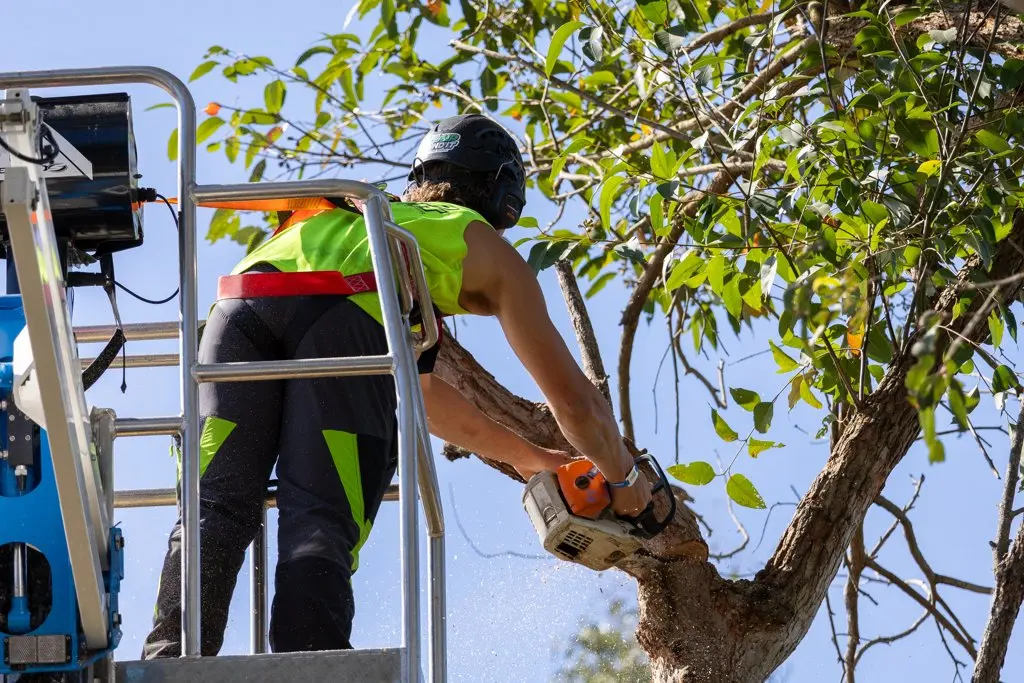
Tree trimming in Brisbane
Every trim starts with one question. What's the tree doing that you'd rather it didn't? A gum dropping limbs over the shed. A jacaranda leaning out across the neighbour's fence. A fig with low branches you duck under every time you mow. Once we know the actual problem, the cuts pretty well choose themselves.
We're a family crew working out of Wishart. Troy started Stump Grind It in 2015 with one grinder. His three boys grew up helping on weekends, finished school, and came on full time. They climb now. We run an EWP as well, which is an elevated work platform, the same machine most people call a cherry picker. Stump grinding is still the specialty, and trimming is the work that stops a tree turning into a removal.
Brisbane yards are full of big trees. The older streets through Holland Park and Tarragindi country were planted decades ago with figs, poincianas, mangoes and camphor laurels, and plenty of those are now well past the size anyone pictured. Newer estates out at Rochedale South and Eight Mile Plains went in with gums and tallowwoods that have put on serious height in twenty years. Then a pool went in. Or a patio, or a second storey. The tree never moved. The house grew towards it.
So most trimming here is about clearance and weight, not looks. We take the dead wood out, lift the canopy off a roof or a driveway, thin it so wind passes through instead of shoving on it, and shorten a limb that's got too long for the wood holding it up. What we won't do is top a tree. Cutting the head off gives you a rotting stub with a flush of weak regrowth on it, and in five years that tree is worse than when we found it. If a tree honestly needs to come down that far, we'll tell you straight and talk about removal instead.
Homeowners are the bulk of it. We also work for body corporates, rental managers before an inspection, and people tidying a place up before it goes on the market. Businesses ring us about car park trees and branches hanging over a loading area.
What you're noticing, and what's behind it
Almost nobody rings up asking for pruning. They ring about a symptom.
Sticks and small branches all over the lawn, week after week. That's usually a gum. Eucalypts shed their own dead wood and they do it on a still day with no warning. A dry spell sets the dead wood up, then a wet summer piles new growth and weight on top of it, and down it comes.
Branches on the roof or sitting in the gutter. Leaves choke the gutter, tiles get scratched loose, and a branch touching the roof is a bridge for possums and rats straight into your ceiling. Gutter guard does nothing about a limb resting on the ridge capping.
Ducking under a limb every time you use the driveway. Low branches mean a canopy that spread sideways instead of up. Every ute, trailer and mower takes a bit off the underside, and those torn stubs are exactly where decay gets in.
Nothing will grow under the tree anymore. A canopy that thick stops light and rain reaching the ground. Thin it properly and you get dappled light back on the lawn.
A limb over the neighbour's fence. That one comes up constantly on the tighter blocks around Mount Gravatt East and Mansfield. Queensland has rules for overhanging branches under the Neighbourhood Disputes (Dividing Fences and Trees) Act, and your council may have its own vegetation rules on top of that. We'll tell you what we can see and what you should check first. If the job needs the neighbour on board, we'd sooner sort that out before we start than halfway through.
Something shifted in the last storm. A hanging limb caught up in the canopy. A split fork. A crack where two trunks are squeezed together with bark trapped in the join, which is called included bark and is a genuine weak point in wind.
Why does this keep happening here? Summer storms roll in off the ranges with real gust in them, and a thick canopy works like a sail. Our clay soils go from concrete hard to sodden inside a week, which loosens the root plate under a tree that was already leaning. Closer to the bay, Capalaba and Alexandra Hills yards cop steady salt wind, so trees there grow lopsided and carry more weight on the sheltered side. And a good share of the trees we inspect were topped by somebody years back, so now they're holding up a dozen skinny regrowth stems out of one old cut. We see that every week.
How a trim runs, from your first call to the last rake
You ring the number and you get Troy. Tell him the suburb, what the tree is if you know it, and how wide the side gate is. That last one matters more than people expect. It decides whether a machine can get out the back, or whether the boys are carrying gear through by hand.
Troy still quotes the jobs himself, and he'd rather stand under the tree than guess off a photo. He'll walk the yard, get in under the canopy, look at the branch unions, work out where limbs have to come down and what's sitting underneath them. Pool, shed, glasshouse, the neighbour's new colorbond. He'll also flag anything that changes the job, like powerlines in the drop zone, or a tree too far gone to be worth pruning.
Then you get the quote in writing with the scope spelled out. Which limbs, how much off, whether the green waste goes or stays. If we open a canopy up and find rot we couldn't see from the ground, we stop and ring you before we do anything else.
On the day we arrive in the window we gave you. Cars off the driveway, pets inside, washing off the line if it's near the drop zone. The boys run a toolbox talk first, set the drop zone up with cones and tape, and keep a ground hand watching for anyone who wanders in.
Then it's climb or EWP. On a tight block with nowhere to swing gear, one of the boys climbs it and we rig limbs down on ropes, piece by piece, lowering them instead of dropping them. Over a pool or a paved entertaining area that's the only sensible way. If the tree's big and the front access is clear, the EWP is quicker and safer.
Cuts go back to the branch collar. That's the slightly swollen ring of tissue where a branch meets the trunk, and the tree can seal a wound made there on its own. Cut flush into the trunk instead and you've opened a hole that never closes over. No stubs left behind, no flush cuts, no pruning paint.
As a rule we take no more than about a quarter of the live canopy in one visit. Push past that and the tree panics and throws weak growth everywhere. If your tree needs more than a quarter off, we'll talk about staging it over a couple of seasons.
Clean up is the part our reviews go on about. Branches go through the chipper, the lawn gets raked, paths and driveways get blown down. Green waste leaves with us. If you want the mulch for the garden beds, say so on the day and we'll drop a pile in the corner.
Last thing, we walk the yard with you. If one more cut needs making, we make it then, not next week.
The gear, and the standard we cut to
We run stump grinders in a few sizes, from a narrow machine that squeezes through most side gates up to something with real bite for a big fig butt. Bog mats go down on soft turf so tracks and tyres don't leave ruts across your lawn. The chipper comes with us so branches aren't sitting on the grass all afternoon. Climbing kit, ropes, friction devices and rigging blocks for lowering limbs under control. Chainsaws from top-handle saws up to the long bar, plus pole saws for reaching into a canopy from the basket. Our EWP gear includes a spider unit, which walks in on tracks and sets up on outriggers in a spot a truck-mounted lift would never fit.
Pruning is done to AS 4373, the Australian Standard for pruning amenity trees. That's the document behind the pruning types we quote: crown lifting, which clears the underside of a canopy off a roof or a driveway, crown thinning, which takes out selected branches so light and wind can pass through, dead wood removal, and selective reduction on one limb that's overextended. The same standard rules out topping and lopping, which is the bad haircut we get called in to repair years later. Chainsaw work follows AS 2727 practice, and we work to the Safe Work Australia guidance for tree trimming and removal.
Powerlines are their own animal. There are exclusion zones around the service line to your house and the mains out the front that untrained crews have to stay clear of, and we're upfront with you about it. If the branches you want gone sit inside that zone, that's a job for your electricity distributor, and we'll handle everything outside it. We'd rather give up half an hour of work than put one of the boys near a live line.
We check for wildlife before the saws start. Hollows, nests, possums and koala habitat. We check for wildlife carefully before we touch the tree. If there's a nest with chicks in it, we'll come back another day and we'll say so.
Underground services get located before we grind anything. Irrigation, electrical conduit, sewer, telco. A grinder finds all of those the expensive way.
When a branch can't wait
We're on the tools 7 days, 6am to 6pm. Outside those hours, call any time for emergencies, 24 hours a day. For anything else, leave a message and you'll hear back first thing.
In the meantime, treat the limb as if it's coming down, because it might. Stay out from under it. Rope a chair across the path or drag the bin over so nobody walks through. Park the car somewhere else, keep the kids and the dog away from it, and don't climb on the roof to have a look. If a limb is on powerlines, across a road, or has come through the house, that's 000. For storm damage to your property, the SES is on 132 500.
Then ring us at six. Troy shuffles the day around. Through a storm week we go after anything over a bedroom, a driveway or a footpath first. Plenty of the time we do a make safe on the first visit: get the hanger out of the canopy, cut a split limb back to a sound point, clear the path, then come back for the full trim and the tidy up once the diary loosens off.
Best move is not needing that call. A trim booked in spring, before the storm season really gets going, takes the weight and the dead wood out while the weather's quiet.
Why people ring us
Our Google reviews are five-star. We didn't buy one of them. What people write about most is the clean up and the straight quote.
Troy still quotes the jobs himself, same as he did in 2015 when it was one man and one machine. Working Brisbane yards since 2015 means he's seen your tree before, or something close enough to it.
The crew is family. Troy's three boys climb, and they've grown up on these jobs. You get the people who did the work standing in your yard at the end of it, not a subbie you've never met.
We cut to the standard, not to whatever's fastest. Branch collar cuts, a quarter of the canopy at most, no topping, ever.
And if the tree has to come out instead of back, the stump is our home ground. Standard grind is 100 to 200mm below ground level, deeper again if you're laying concrete, turf or putting a pool in. That's how the business started and it's still what we do best, from Wishart right through to Eight Mile Plains.
We work from our depot at Wishart and cover most of Brisbane. Tell us the tree, the suburb and the side gate width. Ring Troy on 0400 721 715.
Frequently asked questions
What does tree trimming cost?
It comes down to the tree, the height and how hard it is to get gear in. Troy still does the quotes himself, so ring 0400 721 715 and he'll come and have a look. You get the quote in writing before any work starts.
How much can you take off a tree?
About a quarter of the live canopy in one go, as a rule. Cut harder than that and the tree throws up weak regrowth that's more trouble later. If yours needs more, we'll talk about staging it over a couple of seasons, or about removal.
Do you top trees to keep them short?
No. Topping leaves a rotting stub with weak shoots coming out of it, and in a few years the tree is more dangerous than before. We reduce specific limbs, thin the canopy and lift it off the roof instead. If a tree is genuinely too big for the spot, we'll say so.
Do you clean up afterwards?
Yes. Branches go through the chipper, the lawn gets raked, paths get blown down and the green waste leaves with us. If you'd rather keep the mulch for the garden beds, tell us on the day and we'll drop a pile for you.
Can you get into a tight backyard?
Usually. The boys climb and rig limbs down piece by piece when there's no room to drop them, and we put bog mats under heavy gear so soft turf doesn't get chewed up. Tell us the side gate width when you ring and we'll work out what fits.
What about branches near the powerlines?
There are exclusion zones around the service line and the street mains that we stay out of. We'll do everything outside the zone and point you to your electricity distributor for the rest. No shortcuts near a live line.
A storm has left a limb hanging. Can you come now?
We're on 7 days, 6am to 6pm, and for emergencies you can call any time, 24 hours a day. Stay out from under it, keep the kids and the dog clear, and ring us. Through storm weeks we put anything over a bedroom, driveway or footpath first. If a limb is on the powerlines or through the house, call 000, and the SES is on 132 500.
Do you grind the stump if the tree has to come out?
We do. Stump grinding is where we started back in 2015. Standard grind is 100 to 200mm below ground level, deeper if you're laying concrete, turf or a pool. More at stumpgrindit.com.au or ring 0400 721 715.