
Tree Planting
We plant trees, usually once the grinding's done.
5.0 from 571 reviews
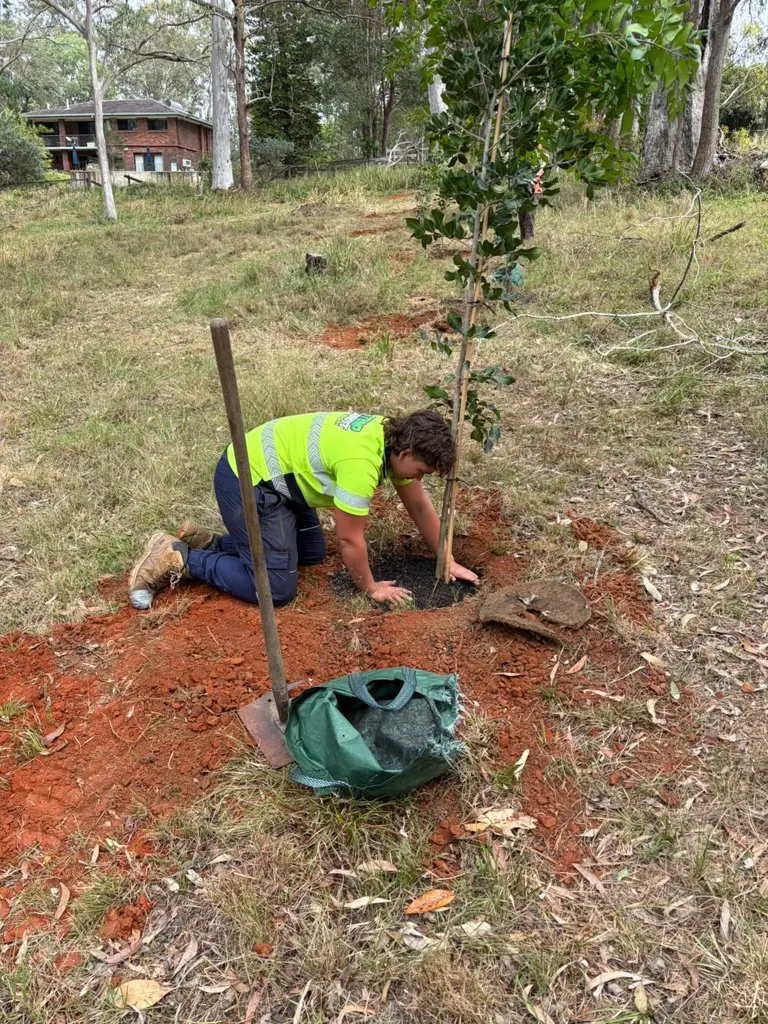
Tree planting in Brisbane
Most of our planting jobs start with a bare patch of dirt. We grind a stump out on the Tuesday, the owner stands there looking at the hole, and asks what can go back in. Fair question. A yard that's had a big tree in it for forty years feels empty without one.
So we plant. Usually straight after the grinding, sometimes months later once you've had a think about it.
This service is for anyone who's lost a tree, or never had one worth keeping. Storm ripped the top out of a poinciana. The camphor laurel had to go before it lifted any more of the driveway. You want a screening row along the back fence because the neighbours went up a storey. Or the front strip cops afternoon sun and the lawn has given up.
Older Brisbane blocks need this more than people realise. A lot of the housing through our Tarragindi and Holland Park patch went up between the fifties and the eighties, on blocks that were generous by today's standards. Those yards got planted with whatever grew fastest: camphor laurel, poinciana, leopard tree, mango. Sixty years on, the shade has either gone or it's coming from a tree that's now a problem. Newer estates out around Rochedale South have the opposite issue. Big roofs, tight setbacks, not much canopy, and a western wall that cooks from two o'clock on.
We also do a fair bit for small business. Childcare centres wanting shade over the play area. Body corporates replacing a row that finally failed. Car parks where the original plantings were put in too small a garden bed and strangled themselves.
We're not a nursery and we won't pretend to be. We're an arborist crew that spends most of the week removing and grinding, so we've seen what the wrong tree in the wrong spot costs. Twenty years later, someone pays us to take it out. The whole reason we talk it through before we dig is so that bill never lands on you.
What you notice, and what's actually going on
The hole that keeps sinking
You backfilled after the grind. It looked level. Three months later there's a dish in the lawn deep enough to roll an ankle in. Woodchip doesn't hold its volume. It rots down, it shrinks, and everything above it drops. The same thing happens to a tree planted into that mix. It sits at the right height for a season, then settles 100mm and the trunk collar ends up buried under soil. Buried collars rot. That's how a healthy young tree dies slowly for no obvious reason.
The tree that went in and never moved
Two years in the ground and it's the same size as the day it left the pot. It's nearly always one of three things. Planted too deep. Planted into fresh grindings. Or the roots never broke out of the shape of the pot.
The grindings one catches everybody. Chip breaking down in the soil pulls nitrogen with it, because the bacteria doing the rotting get first pick and the young feeder roots get the leftovers. The tree isn't diseased. It's hungry.
Roots lifting paths and finding pipes
Figs, poincianas, jacarandas and camphor laurels push roots out wider than their canopy and close to the surface. On the clay and shale under the ridges around Mansfield, roots stay shallow because there's not much air down deep. Sooner or later they meet a path edge, a slab, a boundary fence footing or an old earthenware sewer line. That's the tree we're removing. It's also the reason we ask where your services run before we plant a new one.
Soil that either drowns a tree or starves it
A lot of Brisbane sits on heavy clay over shale. Dig a neat hole in clay, fill it with fluffy potting mix, and you've built a bucket. Water runs in, sits there through the wet, and the roots drown. Out toward the bay around Capalaba it flips. Sandier ground that drains before the tree gets a drink, and salt carried in on the easterly. Different soil, different species, different watering plan.
A yard stripped bare after a storm
November to March we're flat out on storm work. A big limb or a whole tree comes down, we clear it, and the yard is suddenly wide open. No shade on the western side, no screening from the road, nothing holding the bank on a sloping block. Bare soil on a slope moves in the next downpour.
Too big, too close
The dearest mistake we see. A tree bought in a small pot with a tag promising fast shade, planted two metres off the slab. Twelve metres later it's in the gutters, over the fence and into an argument with the neighbour. Blocks in Brisbane have got smaller while houses have got bigger. The planting rules your grandad used don't fit a modern setback.
How we do the job, from first call to done
The call and the quote
Ring 0400 721 715 and you'll usually get Troy. We ask what came out, or what's coming out, and what you want the new tree to do. Shade, screening, birds, fruit, or just something that looks decent from the kitchen window.
Then we come and look. We don't quote planting over text, because the answer changes depending on your soil, your access and what's under the ground.
Working out what goes in
On site we check the aspect, how wet the spot stays, what's overhead, and how far it is to the slab, the fence, the pool and the drains. We ask what the mature size can be, not what you want it to be in year two.
If you want shade over a back deck in a big yard, a tallowwood or a tulipwood earns its keep. If the spot is three metres from a path, we'll steer you to a water gum, a tuckeroo or a lilly pilly instead. Screening a two storey behind you usually means a row of weeping lilly pilly or magnolia at set spacings, not one tree in the middle. Out Redlands way, if you want a tree the koalas actually use, tallowwood and grey gum are the ones worth planting.
You can buy the stock yourself and we'll put it in. Or tell us what you're after and we'll source it.
Clearing the grindings out
Where we've ground a stump, we dig the chip back out of the hole and cart it off, or spread it as mulch somewhere it can do some good. Then we backfill with soil, not chip. If you're not in a hurry, leaving the grindings to break down over a season works too, and we'll say so rather than sell you a job you don't need.
Finding the services
Before anything goes in the ground we lodge a Before You Dig Australia enquiry and run a locator over the spot. Water, sewer, power, gas, irrigation, pool lines. Plenty of Brisbane yards have had three owners and two renovations, so the plans and the reality don't always match.
Digging and planting
The hole goes at least twice as wide as the root ball and no deeper. Dig deeper than the ball and the tree settles. On clay we rough up the sides so roots aren't sliding around a glazed wall, and we often plant slightly proud with a low mound so water moves away from the collar.
We slide the tree out and check it. Roots circling the pot get teased out or cut. We set the root flare, the spot where the trunk widens into the roots, at or just above finished soil level. Backfill goes in with the soil that came out, plus compost if the ground needs it, firmed in layers so there are no air pockets.
Then a heavy soak to settle it, and a shallow basin around the edge of the root ball so water goes where the roots are.
Staking, mulch and clean up
Stakes go in only if the site's exposed. Two stakes, clear of the root ball, hessian or webbing ties tied loose so the trunk can still move. Movement is what builds trunk taper. We'll tell you when to pull them out, usually inside twelve months.
Mulch goes on 75 to 100mm thick, pulled back a hand's width from the trunk. Volcano mulch piled against the bark is how young trees rot at the base. If you've got a dog or a keen whipper snipper operator, we'll put a guard on.
We blow down the paths, rake the lawn and take our mess with us. The clean up is the bit our customers mention most in reviews.
The first summer
Before we leave, you get a watering plan. Deep soaks, not daily sprinkles, tapering off as it establishes. We'll tell you what the first sign of trouble looks like so you can ring us early instead of late. Happy to come back and do the formative pruning as it grows.
Gear and standards
Our narrow access grinder fits through most standard side gates, so the stump comes out and the planting spot gets prepped without dropping a fence panel. On soft turf we lay bog mats to keep the machine off the lawn, which matters after rain. For a screening row of eight or ten, we'll bring an auger rather than dig every hole by hand. In shale you still end up on a crowbar, there's no way around it.
We check nursery stock against AS 2303, the Australian Standard for tree stock. In plain terms that means a firm root ball with no roots strangling the trunk, one strong leader, and a trunk that tapers instead of running up like a broomstick. A cheap pot bound tree is dear in the long run.
Later pruning follows AS 4373, the Australian Standard for pruning amenity trees. If we're planting near an established tree that's staying, we keep the digging outside its root zone the way AS 4970 sets out, because you can kill a mature tree by trenching through its roots for a new one.
Council rules matter too. Brisbane City and Redland City both have protected vegetation and street tree rules, and they aren't the same. We'll tell you what needs checking before we start, and we don't put a tree in a verge without approval.
If the only decent spot is close to a path or a slab, we'll talk about a root barrier panel, or we'll talk you out of that species and into a better one.
When it's urgent
Planting is rarely the emergency. The removal usually is.
Storm season in Brisbane runs November to March, and when a tree comes down we treat the make safe as the priority. Clear the hazard, get the yard usable, grind the stump, then sit down about what goes back. Replanting a week later in soaked ground does the new tree no favours anyway.
There are deadlines that do move us up the list. A settlement date. A rental inspection. A removal approval that came with a condition to replant, in which case bring us the paperwork and we'll work to it. A childcare or body corporate site that needs shade in before the hot months. Tell us the date on the phone and we'll be straight about whether we can hit it.
We're on the tools 7 days, 6am to 6pm. Outside those hours, call any time for emergencies, 24 hours a day. For anything else, leave a message and we call back first thing.
Our depot is at Wishart and we work across Brisbane.
Why people get us to do it
Troy started Stump Grind It in 2015 with one grinder. Tree crews back then didn't want to leave a bloke behind to grind the stump, so he filled the gap. His three boys grew up helping on weekends, and came on full time out of school. It's still the family running the jobs.
We'll always explain how we quote. You'll get told what we're doing and why, in words that make sense, before anyone starts the machine.
Our Google reviews are five-star. Read a few and you'll see the same things over and over: turned up when they said, no hidden costs, cleaned up after themselves. That's the whole business model.
Because we remove and grind every week, we plant with the removal in mind. We know which species lift paths on clay, which ones handle the salt out near the bay, and which ones a homeowner will be cursing in fifteen years. That's worth more than a tag on a pot.
We'll also tell you when not to plant. If the spot's too tight, or the wet season's about to hit, or the grindings need another few months to break down, we'll say so.
Got a bare patch where a stump used to be? Ring Troy on 0400 721 715 and we'll come and have a look at it.
Frequently asked questions
Can you plant straight into the hole where the stump was?
Not straight away. Grinding leaves a hole full of woodchip, and that chip pulls nitrogen out of the soil as it breaks down, so young roots struggle. We dig the chip out, backfill with soil, and plant into that. If you're not in a rush, leaving the grindings to rot down for a season works too.
What does tree planting cost?
Depends on the tree, the size, how many, and whether we're clearing old grindings out first. We don't guess over text. Ring Troy on 0400 721 715 and you'll get a straight number before any work starts.
Do you supply the tree or do I?
Either way suits us. Plenty of customers pick their own at a nursery and we just put it in properly. If you'd rather we sorted it, tell us what you're after, shade, screening, or something low that won't lift the path, and we'll suggest a few that handle south east Queensland conditions.
How close to the house, fence or pipes can I plant?
Further than most people think. A big gum or fig needs root room about as wide as its canopy. Near a slab, a sewer line or a boundary fence, we'll point you to something smaller instead. We lodge a Before You Dig enquiry and run a locator over the spot before we put a spade in.
When's the best time of year to plant in Brisbane?
Autumn and early spring are the easy windows. Warm soil, less heat stress, and the tree gets roots out before summer. We plant year round though. Mid summer just means a tighter watering plan for the first couple of months.
What should I plant to screen a two storey next door?
A row, not a single tree. Weeping lilly pilly, magnolia or a tuckeroo at set spacings will give you a solid screen without roots chasing the fence footings. We'll work out the spacing on site based on how much fence you're covering.
Do you look after it after planting?
We stake it if the spot's exposed, mulch it, and leave you with a watering plan for the first few months. After that it's on you, though we're happy to come back and prune it as it grows. Ring us on 0400 721 715 if it starts looking unhappy.
Do I need council approval to plant a tree?
In your own yard, usually not. Verge and street trees are a different story, and Brisbane City and Redland City each have their own rules, plus protected vegetation overlays on some blocks. We'll tell you what needs checking before we start.