
Tree Lopping
Tree lopping is cutting back a tree's height or limbs, usually when branches are hanging over a roof, a fence or the powerlines.
5.0 from 571 reviews
Tree lopping in Brisbane
Most people who ring us about tree lopping want the same thing. A branch is over the roof, or the fence, or the powerlines, and they want it gone before the next storm rolls through.
Fair enough. We'll just be upfront about the method. Old-school lopping means cutting a tree back to stubs. It looks tidy for a season. Then the tree throws out a mess of fast regrowth off those cut ends, weakly attached, and in three or four years you've got more weight sitting in a worse spot than when you started. We've removed plenty of trees that were only dangerous because someone lopped them back in the 90s.
So we prune instead. Our arborists take the limbs that have to go, cut them back to a proper growth point, and leave the tree balanced. You get the clearance you rang about. The tree keeps its shape and seals over the wound. If it's too far gone for that, we'll tell you and walk you through a removal rather than pretending a prune will fix it.
We're a family crew out of Wishart. Troy started with one stump grinder in 2015, and his three boys grew up helping on weekends. They're the ones up the tree now. We work from our depot at Wishart and cover most of Brisbane and out to the bayside.
Who calls us? Homeowners on the old brick-and-tile blocks, where a gum planted in the 70s is now 20 metres of timber leaning over the bedrooms. Body corporates with a poinciana lifting the driveway. Agents wanting a pre-sale tidy. Businesses with limbs hanging over the staff carpark. And plenty of people who simply can't get the mower under a tree any more.
Half the time the tree work and the stump go together. We grind, we always have, so once the limbs or the whole tree are down the stump doesn't sit there for six months waiting on a second crew. Around Wishart and Mansfield we'll often knock both over in the one visit.
What you're noticing, and what's behind it
Here's what people describe on the phone, and what's usually going on underneath it.
- Branches sitting on the roof. Tile roofs cop a hiding from limb rub. A gum or jacaranda branch resting on the ridge in a westerly will shift tiles and let water through, and you won't know until there's a stain on the ceiling. Gutters packed with leaf are the other half of that story.
- Limbs up near the powerlines. The service line running from the street to your house is the one that worries people most. Clearance distances apply, and some work close to the lines belongs to Energex or an accredited provider rather than us. We'll look at it and tell you which side of that line your tree sits on.
- Dead wood in the canopy. Grey, bare limbs with no leaf on them. Eucalypts shed those, and they'll do it on a still hot afternoon with no wind at all. That catches people out. If it's hanging over a patio or a trampoline, it goes first.
- A crack at a fork. Big figs and poincianas often grow two stems of equal size out of the one point, with bark trapped in the join. That join is weak. Once it starts opening up, half the tree can let go in a storm.
- Roots lifting the path or the lawn. Figs, poincianas and jacarandas run roots along just under the surface, and they'll hump a footpath or a driveway edge. Pruning the top won't change that, so we chase the roots back where we can and grind them out.
- Too much shade, too much leaf in the pool. Not a safety job, just a livability one. Thinning and lifting the canopy gets light back into the yard without wrecking the tree.
- A hanger left over from the last big blow. Limb's broken but it hasn't come down. It's caught up in the fork, waiting.
Why Brisbane gets so much of this comes down to how these suburbs were built. Most were filled out between the 1960s and the 1980s, and the trees went in with the houses. Gums, figs, poincianas, mangoes, all planted a few metres off a brick-and-tile place on a block that felt roomy at the time. Fifty years on, those trees are mature and the houses haven't moved. Blocks have been split and rebuilt since, so there's more roof and less room to work. Add the clay soils out through Mount Gravatt East and Holland Park, which swell in the wet and shrink back in the dry, then a storm season that dumps rain before it brings the wind gust, and limbs come down. Then there's the previously lopped trees. Those are the ones we get called to most often.
How the job runs, from first call to clean-up
You ring the mobile. Troy quotes the jobs himself, so you're talking to the bloke who'll be on site, not a call centre. He'll ask what the tree is, what's under it, and how we get in. Side gate width matters more than people expect, so have a rough measurement if you can.
Then we come and look. We do quotes in person, because you can't price a tree off a photo when there's a pool, a shed and the neighbour's carport in the drop zone. You get the price in writing before any work starts.
Once you're happy, we book a day. We start early, from 6am, which suits people who want us gone before the kids nap or the shop opens. We'll let you know roughly when we're pulling up.
On the day, the first thing we do is walk the site again. Where the chipper sits, where the truck goes, which way the limbs come down, where your irrigation and pool lines run. If the ground's soft we put bog mats down so the turf doesn't get chewed up. Cars get moved, furniture gets shifted, the dog goes inside.
Then the tree work. One of the boys climbs, or we bring the spider EWP through if there's room. EWP means elevated work platform, a cherry picker. In a tight backyard nothing gets dropped: limbs are cut in sections, roped off, and lowered under control so they land where we want them. Bigger pieces get taken in bites. It's slower than dropping timber and it's the reason we can work over a pergola or a glasshouse without wrecking it.
Cuts get made at the right points, back to a lateral branch or the collar, no stubs and no flush cuts into the trunk. That's the difference between a tree that heals and a tree that rots from the cut inward.
Branches go through the chipper as we go. Site gets raked and blown before we pack up, and customers tell us that's the bit they notice most. If you want the mulch left for the garden beds, say so on the day and we'll tip a pile where you want it.
If the tree's coming out entirely, the stump goes next. We grind generally 100 to 200mm below ground level, deeper where you're putting in concrete, a pool or a new build. Roots get chased where they're lifting paving. Then you can turf or plant straight over the top.
Invoice comes after, once the job's done.
The gear, and the standards we cut to
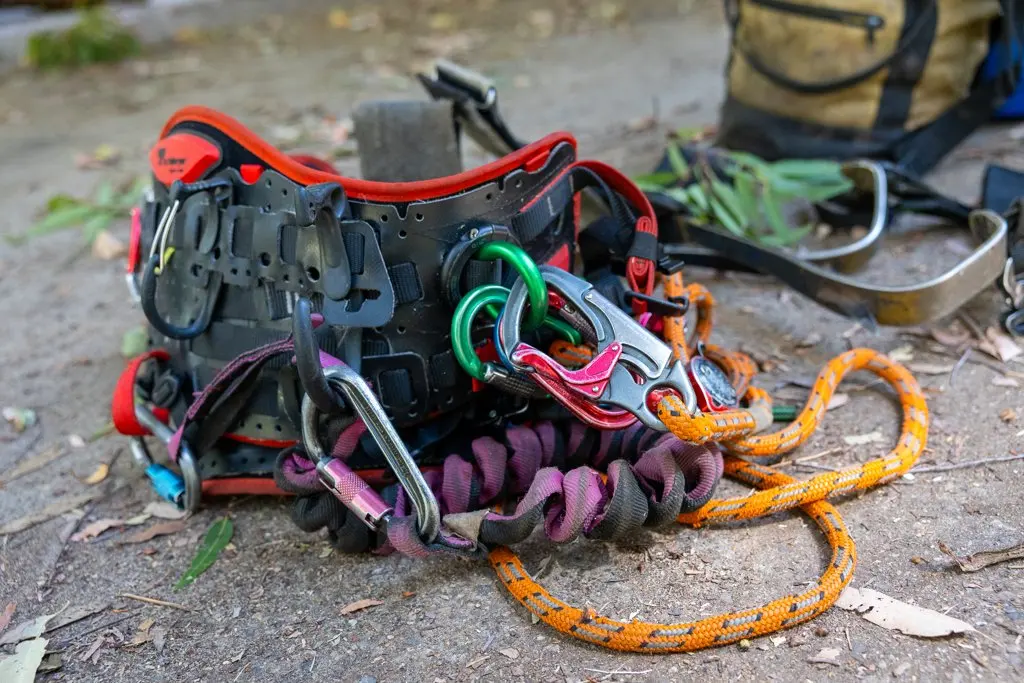
Climbing work is done on rope with proper rigging: lowering lines, pulleys and friction gear so a limb can be held, cut, and let down slowly. On a tree we're keeping, the climber works without spikes, because spiking a trunk you intend to leave standing just puts wounds in it.
The spider EWP is tracked, not wheeled. It's narrow enough to go through a side gate, it'll walk up and down steps, and it spreads its weight rather than sinking into wet lawn. That gets us to canopy work in backyards where a truck-mounted unit would never get past the letterbox.
Grinders come in a few sizes. The small one fits through a standard gate. The bigger ones do driveway-front gums and multiple stumps in a day. Before any grinding starts we locate what's underground: irrigation, gas, comms, pool plumbing. Cheaper to find it with a locator than with a cutting wheel.
On standards, the pruning benchmark in Australia is AS 4373-2007, Pruning of amenity trees. That's the one that sets out target pruning cuts, crown thinning and crown lifting, and it's why we won't do stub cuts. If you're building, AS 4970-2009 covers protecting trees on development sites, which matters when a certifier or your development approval specifies a tree protection zone. EWP work follows the safe use requirements under the AS 2550 series. Anything near the powerlines follows Queensland electrical safety clearance rules, and we'll be honest about where our work stops and Energex starts.
Wildlife gets a look before the saw goes in. Hollows, nesting birds, possums. Where a job sits near koala habitat we take extra care, because that's what you do. Takes an extra phone call and it's worth it.
Worth knowing too: some Brisbane trees are covered by council vegetation protection, and a few blocks carry conditions from an old development approval. We'll flag it if we reckon yours might be one. Better to ask before than to explain after.
When it can't wait
We're on the tools 7 days, 6am to 6pm. Outside those hours, call any time for emergencies, 24 hours a day. For anything else, leave a message and we'll come back to you first thing.
What we do handle is genuine make-safe work, and in storm season the phone runs hot from about November to March. When you call, tell us what's above the limb and what's below it. A hanger over a footpath, a driveway, a bedroom or a pool fence jumps the queue ahead of a prune that's been waiting three weeks. Photos texted through help us work out whether it's a climb, an EWP job, or a call to Energex.
If powerlines are involved, ring Energex before you ring us and keep everyone well clear. Don't go poking at it with a pool scoop. Same goes for a limb that's split but hasn't dropped: the loose one is the dangerous one, and it can come down with no warning at all.
On a make-safe we take the weight off, get the broken timber out of the canopy, and cut back to sound wood so the tree isn't a hazard while you sort out the rest. Tarping a roof or boarding a window is a builder or insurer job, not ours. We'll give you a written scope and photos for the claim if your insurer wants them. Out around Capalaba and Tarragindi we get to the urgent ones first, depending on where the crew already is.
Why people give us the job
Our Google reviews are five-star. We're pretty proud of that, and the same two things come up in them: the crew turned up when they said, and the yard was left cleaner than they expected.
We've been at it since 2015, so we know Brisbane backyards, side gates and gums growing through the Hills hoist. Troy still quotes the jobs and still runs a grinder. The boys are the ones climbing and rigging now, which means the person cutting your tree has a reason to care how your fence looks afterwards.
We're straight about what a tree needs. If a prune gets you the clearance, we'll prune it. If the tree is hollow, leaning on the house or past saving, we'll say that instead of selling you a trim that buys two years. And because stump grinding is where we started, a removal doesn't leave you chasing a second contractor for the lump in the lawn.
No hidden costs.
Got a limb over the roof at Mansfield, or a jacaranda taking over the yard out at Holland Park? Ring Troy on 0400 721 715, or send through a photo and we'll book a look. You can also head to stumpgrindit.com.au.
Frequently asked questions
What does tree lopping cost?
It depends on the tree, the access, and what's sitting underneath it. Troy quotes the jobs himself, so ring 0400 721 715 and we'll sort out a time to come and look. No hidden costs, and you get the price in writing before we start.
Why do you recommend pruning instead of lopping?
Lopping cuts a tree back hard and leaves stubs. The tree responds with fast, weakly attached regrowth off those cuts, and that's the stuff that drops in a storm. Proper pruning takes whole limbs back to the right points, so the tree seals the wound and stays safer. You still get the clearance you were after.
Can you reach a tree in a tight backyard?
Usually, yes. One of the boys will climb it and we'll rope the limbs down in sections rather than dropping them. Where there's room we walk the spider EWP through, which is an elevated work platform, a cherry picker on tracks. Tell us your side gate width when you call and we'll plan the gear around it.
Do you take the branches away?
We do. Limbs get chipped and the site raked and blown before we pack up. Customers tell us the clean-up is the bit they notice most. If you'd rather keep the mulch for the garden beds, just say so on the day and we'll leave a pile.
What if the tree needs to come out completely?
We'll tell you honestly. Some trees are too hollow, too close to the house, or too far gone to prune safely. We do full removals and grind the stump after, generally 100 to 200mm below ground so you can turf or plant over it.
Can you prune a tree that's grown into the powerlines?
Depends how close it is. Clearance rules apply near the lines, and some of that work belongs to Energex or an accredited provider rather than us. We'll come and look, tell you plainly which side of that line your tree sits on, and do the part we're allowed to do.
Do you work after storms, and are you available at night?
We work 7 days, 6am to 6pm, and in storm season we push urgent make-safe jobs to the front of the list. Outside those hours, call any time for emergencies, 24 hours a day. For anything else, leave a message and we'll ring back first thing. If powerlines are involved, call Energex first and stay well clear.
Do I need council approval before you prune?
Sometimes. A few Brisbane trees are covered by council vegetation protection, and some blocks carry conditions from an old development approval. We'll flag it at the quote if we think yours might be one, so you can check before we start.
Which suburbs do you cover?
We work out of our Wishart depot, across Brisbane and out to the bayside. That includes Mansfield, Mount Gravatt East, Upper Mount Gravatt, Holland Park, Tarragindi, Eight Mile Plains, Sunnybank Hills, Rochedale South, Shailer Park, Capalaba and Alexandra Hills. Call 0400 721 715 if you're not sure.