
Stump Grinding
Stump grinding is what we started with back in 2015, and it's still the job we like best.
5.0 from 571 reviews
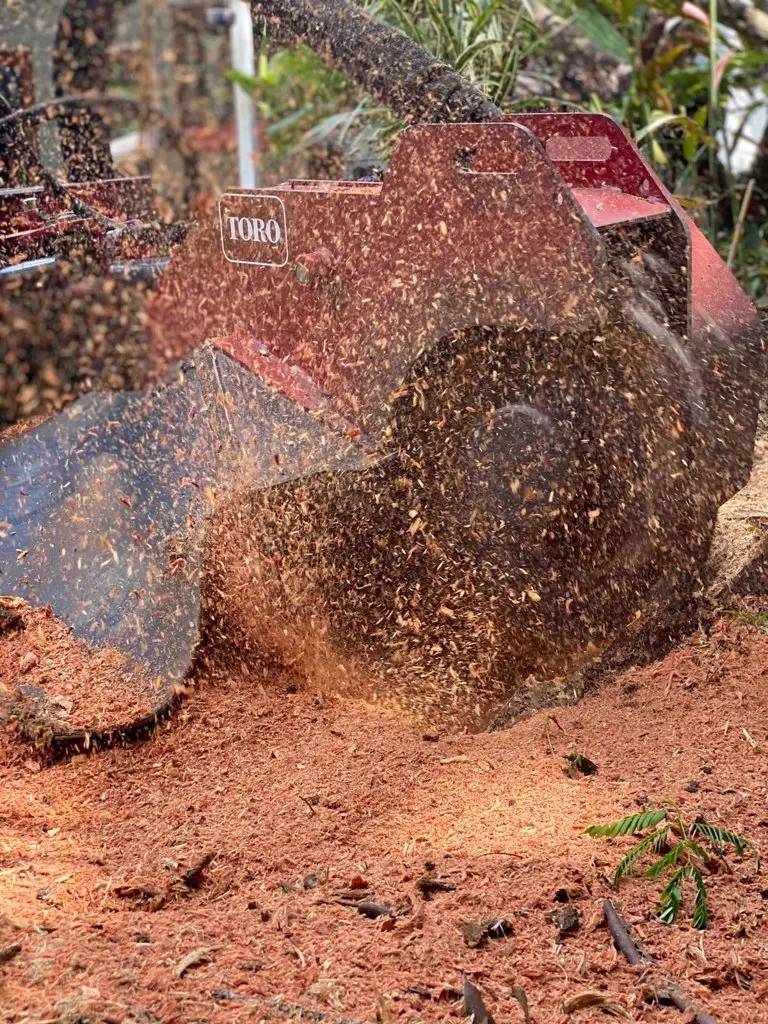
What stump grinding is, and who it's for
Stump grinding means cutting a leftover tree stump down below ground level with a machine built for that one job. A steel wheel fitted with carbide teeth spins at speed and shaves the timber off in thin layers. No digging a crater, no poison, no chain on the towbar. A lump of hardwood in the middle of your lawn turns into a hole full of woodchip, and most single stumps take under an hour.
People mix up grinding and digging out, so here's the difference. Digging a stump out means an excavator, a hole the size of a spa, a truck for the spoil and a yard that needs rebuilding afterwards. Grinding leaves the surrounding ground alone. The machine works from above, the roots stay where they are and rot down quietly, and you can lay turf over the top the same week. On a suburban block with fences, pipes and a nice bit of lawn, grinding is nearly always the sensible option.
Standard depth for us is 100 to 200mm below ground level. That's plenty for turf, a garden bed or a mower deck. Tell us at the quote if concrete, pavers, a shed slab, a pool or a new build is going over the top, and we'll take it deeper and chase the root flares out wider while we're there.
This is where the business started. Troy bought one grinder in 2015. Tree crews were happy to drop a tree, but nobody wanted to leave a bloke behind for half a day to deal with what was left in the ground. He saw the gap and filled it. Since 2015 we've grown into a full tree crew with his three boys in it, and stumps are still the work we like best.
The calls come from two directions. Either a tree has just come down and there's a fresh stump sitting in the yard, or someone has bought a house in Brisbane and inherited a stump that's been rotting away for years. Fresh ones are easier to quote because we can see the collar and the flare. Old ones hide things. A paver edge, an old clothesline footing, a star picket someone drove in beside it in 1994.
It isn't only houses. We grind for body corporate common areas, schools and childcare yards, agents getting a place ready for an open home, turf layers who can't roll out over a lump, and builders who need a pad clear before the slab goes down. Brisbane has the stock for it. Older blocks carry 70 year old shade trees that are now at the end of their run, and the newer estates have yards small enough that one stump eats half the usable space.
Wishart is home base. We've written up the suburbs we work in most, including Mansfield, Holland Park and Wishart itself.
What you notice, and what's actually going on
Most people don't ring us about a stump. They ring about what the stump is doing.
The mower is the usual one. You clip the edge of it once and the blades are chipped, or worse, the deck cops a hit. Then there's the trip hazard. A cut off stump disappears under a week of lawn growth, and it catches kids, visitors and anyone walking a bin out in the dark.
Termites come up in nearly every quote, and fairly so. Brisbane sits in a high pressure termite area, and a dead, damp stump is exactly what they're after. Coptotermes will set up in rotting timber and then go looking for the next feed, which might be your bearers or the pine sleepers around the veggie patch. Pest inspectors flag stumps for that reason. If there's a line in your inspection report about a stump sitting a few metres off the house, that's what it means.
Regrowth catches people out too. Camphor laurel, Chinese elm, poinciana and a few of the gums will shoot straight back from the collar and the lateral roots. You cut the shoots off, they come back thicker. Poison painted on a cut face doesn't always reach the growth points. Grinding takes the collar out, which is where most of that energy is stored.
Then the slow problems. Surface roots keep lifting long after the tree is gone. Figs, poincianas, jacarandas and leopard trees run wide and shallow, and those roots push up lawn, path slabs, driveway edges and the bottom course of a retaining wall. A stump left to rot leaves a void as well. Two or three years later there's a soft dip in the lawn that holds water after every storm, often with toadstools ringed around it. Rats, snakes and cane toads like the hollow underneath. Fence line stumps are their own headache, because the roots and the regrowth are half in the neighbour's yard and nobody wants that conversation.
So why so much of it here? The older suburbs were carved up when a quarter acre block came with a big shade tree out the back, and those trees are coming down now. That's a lot of what we see on the established streets, which is part of why we wrote a full page on Tarragindi. Heavy clay along the ridges around Mansfield and Wishart holds moisture against a stump and rots it from the middle out, so the timber goes punky in the centre and stays hard as iron on the shell. Roots run wider and shallower in the sandier bayside soil, which we get into on our Capalaba page. Newer estates have the opposite problem: small yards, close fences, pool pipes and irrigation through the lot, and a side gate that barely clears a wheelbarrow.
How we do the job, first call to raked off
It starts with a phone call, usually to Troy on 0400 721 715. Photos help more than a description, so text us three if you can: the stump with a boot or a shovel beside it for scale, the side gate, and the path from the gate to the stump. That's enough for us to price most jobs without a site visit, and enough to know which machine to load.
The quote covers diameter at ground level, the timber, how many stumps there are, the ground conditions, the slope, the access width and what's going in over the top afterwards. Hardwood grinds slower than a mango or a palm. Ten little stumps in a row often work out cheaper each than one old fig. You get the quote in writing before any work starts.
Before a wheel turns, services get located. We lodge a Before You Dig Australia enquiry for the mains and then run a locator over the work area for the private stuff, because private services never show up on those plans: pool power, irrigation, gas to the barbecue, lead-in cables, septic and greywater lines. Where we aren't certain, we hand dig to prove it. That's cheap compared with hitting a live cable.
Then we protect the yard. Bog mats or boards go down on turf so the machine doesn't rut it, and ply goes over pavers and aggregate on the walk in. Screens go up if there are windows, cars, a pool or a neighbour's washing in the chip line. Pots, hoses and dog toys get moved. We rake the area and scrape the dirt off the top of the stump, because grit blunts teeth fast and loose rock flies. That's also when we find the interesting bits: reo bar, old fence wire, buried concrete, a length of poly pipe nobody remembered.
The grinding itself is repetitive and that's the point. The wheel sweeps across the face and takes a layer off, drops, and does it again. We work down past ground level to the depth we agreed, then step out and take the root flares where they leave the stump. If you've asked for root chasing, we follow the offenders out and grind them down where they're lifting lawn, paths or driveway. We'll walk you around first and point out which roots are worth doing and which ones can stay put and rot down on their own. Most single suburban stumps take under an hour on the machine. Big figs, camphor laurels and multi stem clumps take longer, and we'll say so up front rather than turning a half day into a surprise.
Depth gets checked with a tape and a shovel, in front of you if you're home. Then it's your call on the grindings. They can go back in the hole and get levelled with a slight crown, because woodchip settles over the following few months and you want it proud rather than dished. Or we load them out and leave clean soil ready for turf. Grindings are woodchip, not topsoil, so if a garden bed or a new tree is going in the same spot we'll usually suggest carting them away and bringing soil in.
Last job is the clean-up. Rake, blow the paths and driveway, hose it down if it needs it, gate shut behind us. We take the mess with us. The clean-up is the thing people mention most in our reviews, so we don't cut it short to get to the next job.
Tight side access is normal in the newer parts of Brisbane, and it shapes how we plan jobs like Eight Mile Plains. If a gate really is too narrow, we'll tell you when we quote, not after we've turned up with a machine that won't fit.
Our gear, and the standards behind it
Two grinders cover nearly everything around Brisbane. The narrow one is the machine people care about. It fits through a standard side gate, handles a set of steps with a bit of planning, and gets into courtyards and body corporate gardens where nothing bigger has a hope. The bigger machine comes out for acreage, paddock stumps, old figs and camphor laurels, and anywhere we can back a trailer in. Both run carbide teeth and we keep them sharp, because blunt teeth burn time and time is what you're paying for.
Around them sits the rest of it: bog mats and boards, ply for paved walkways, chip screens, a cable locator, rakes, a blower and a tarp for the load out. We're a full tree crew as well, so there's climbing gear and a spider EWP in the yard. EWP means elevated work platform, the machine most people call a cherry picker. That matters when the tree is still standing and has to come down before there's a stump to grind at all.
On standards, here's what genuinely applies to this work. Our helmets, eye protection and ear muffs are the rated gear, so AS/NZS 1801 for helmets, AS/NZS 1337.1 for eye protection and AS/NZS 1270 for hearing protection. Chainsaw work follows AS 2727 for safe working practice. Pruning is done to AS 4373, the Australian standard for pruning amenity trees. On building sites we work to AS 4970, which covers protecting trees through development and the tree protection zone around anything that's staying. Underground services get handled the way SafeWork expects: located, marked, then hand verified where there's any doubt.
One thing worth knowing about permits. Council rules on protected vegetation apply to removing or pruning a living tree, not usually to grinding a stump that's already on the ground. If we think your job needs a look from Brisbane City Council first, you'll hear it from us before it's booked in. Builders and body corporate managers who need our paperwork on file before we come on site, just ask and we'll send it through.
When it can't wait
A stump isn't often a real emergency, but urgent versions exist and we treat them differently.
Storm season is the big one. From November to March a tree comes down across a driveway or a fence and the yard is unusable. Make safe comes first: weight off the structure, access cleared, then the stump and the root plate once the pressure is off. Turf going down on Monday, a settlement date, an open home on Saturday, a termite report the buyer wants cleared, a slab pour already booked with the concreter. They all land in the same basket. Ring us and say it's tight. We'll tell you straight whether we can get there in time, which is more use to you than a maybe.
Our hours are 7 days, 6am to 6pm. Outside those hours, call any time for emergencies, 24 hours a day. Early starts are normal for us, so a 6am kick off is often how an extra urgent job gets squeezed in before the heat.
While you wait, a few things help. Mark the stump with tape and a star picket or a witches hat so nobody walks into it. Keep the mower well off it. Keep kids and dogs clear if there's a hole or exposed root. Don't burn it. Don't tip stump killer or diesel on it if we're already booked, because it won't speed anything up and the grinder still has to do the same work.
Why people call us
Our Google reviews are five-star, and the same three things keep turning up in them. The quote was straight. The crew arrived when they said. The yard was left clean. That's most of the pitch.
We've been at this since 2015, and stumps were the first thing we ever did rather than a sideline bolted onto a tree business. Troy still quotes jobs and still runs a grinder. His three boys work in the business, so the fella doing your job knows what a fig root does under a path and what a dry gum stump does to a set of teeth.
We're careful with the things that aren't ours. Bog mats on the lawn, services located before we start, a heads up to the neighbours when the machine has to come down a shared side. Where wildlife is part of the picture we take extra care and do a wildlife check because the site calls for it.
If the tree is still standing, you only need one crew. Removal, pruning, deadwood, storm make safe and the stump, one visit and one invoice.
Ring Troy on 0400 721 715, or text photos of the stump and the side gate and we'll come back with a price. We cover Brisbane, from Holland Park through to Capalaba.
Frequently asked questions
What is tree stump grinding?
Tree stump grinding is machine removal of a leftover stump, where a steel wheel covered in carbide teeth shaves the timber down below ground level instead of digging it out. Standard grind depth is 100 to 200mm, which is enough for turf, garden beds and mowing. Stump diameter, the timber, how many you have and whether the machine can physically reach the spot are what move the price, so ring 0400 721 715 for a real figure on your job.
How does stump grinding work?
It works by mechanical cutting rather than chemicals: a wheel of carbide teeth spins at high speed and sweeps across the stump, taking off a thin layer each pass until the timber is below ground level. Most single suburban stumps take under an hour on the machine, and the whole visit including setup, root flares and clean-up takes longer. Dense hardwood, big diameters, buried concrete and a narrow side gate all add time. The deeper roots stay in the ground to rot down on their own, then the grindings either go back in the hole or get carted away. Book it in on 0400 721 715.
How deep do you grind the stump?
Standard is 100 to 200mm below ground level, which suits turf, garden beds and mowing. If you're pouring concrete, laying pavers, putting in a pool or building over the spot, tell us up front and we'll go deeper and wider. Same if a new tree is going back in the same hole.
What does stump grinding cost?
It comes down to stump size, the timber, how many stumps there are and how hard it is to get a machine in. We'd rather give you a real number than a guess, so ring Troy on 0400 721 715 and we'll quote it properly. You get the quote in writing before we start.
Can you get into my backyard?
Usually, yes. Our narrow grinder goes through a standard side gate and can handle steps with a bit of planning. Text a photo of the gate and the path when you call so we know which machine to bring. If the access is genuinely too tight we'll tell you straight and talk through the options.
What happens to the surface roots?
We can chase them. Figs, poincianas, jacarandas and leopard trees send roots out wide and shallow, and they lift lawns, paths and driveway edges. Root chasing means following those roots out from the stump and grinding them down as well. We'll walk the yard with you and point out which ones are worth doing and which can stay.
Do you clean up afterwards?
Always. The grindings can go back in the hole and get levelled off, or we cart them away and leave you clean soil ready for turf. Just tell us which you'd prefer. We rake and blow the area before we pack up, and we shut the gate behind us. Book on 0400 721 715 or at stumpgrindit.com.au.
Can I lay turf or plant straight after the stump is ground?
Turf, yes, as long as the hole is backfilled and levelled properly first. Grindings are woodchip rather than topsoil, so for a garden bed or a new tree we'd normally cart the chip away and bring in soil instead. Backfilled grindings also settle over a few months, so we leave them with a slight crown and you may want to top up with soil later.