
Tree Consulting
A tree consult is a site visit where we look at the tree from the roots up and tell you straight whether it stays, gets pruned or comes out.
5.0 from 571 reviews
What a tree consult actually is
Something about a tree in your yard has started bothering you. You want a straight answer, not a sales pitch. That's the job.
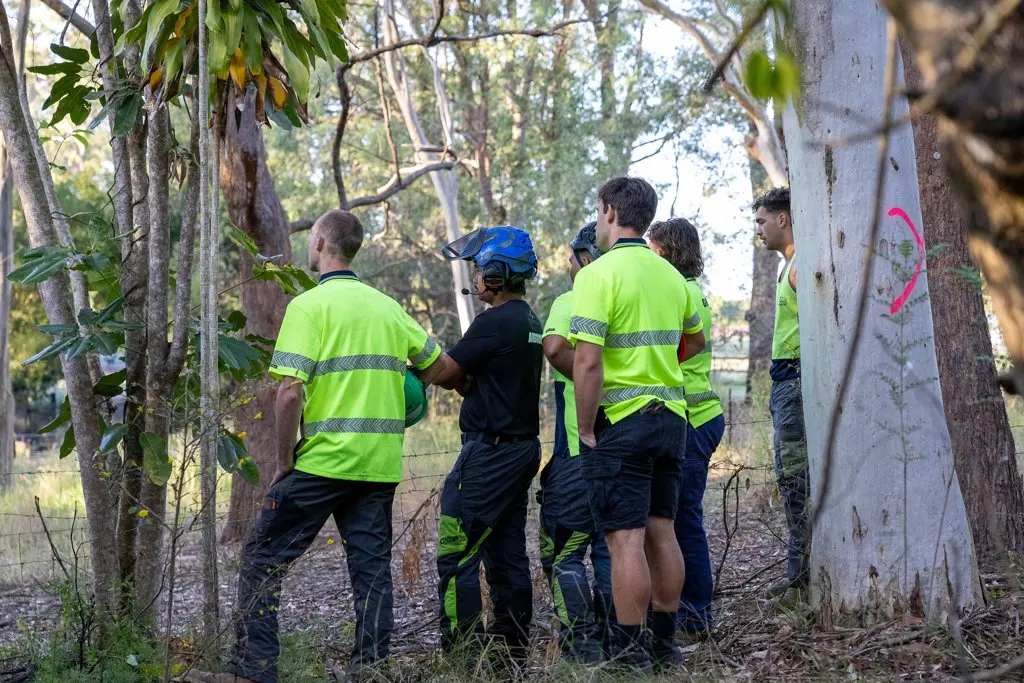
A tree consult is a site visit. One of us comes out, walks the block with you, looks at the tree from the roots up, and says what we're seeing. Keep it, prune it, or take it out. You get a written quote and a clear scope for whatever work makes sense, then you decide in your own time.
We're not here to sell you a document. If a council, a solicitor or a tribunal has asked for a formal arborist report, that's a different piece of paper with its own template, and we'll say so on the day rather than take your money for the wrong thing. What you get from us is the read from the people who'd do the work, including whether the work needs doing at all.
Most consults end up back at the stump. That's where we started in 2015 and it's still the specialty, so we'll tell you what's involved in getting the root plate out as well as how the tree comes down.
A consult usually runs twenty minutes to an hour, depending on how many trees you've got. Big blocks and body corporate sites take longer, because we'll walk the whole site and give you an order of priority instead of one answer.
Typical callers:
- A homeowner with a gum or a fig that's started dropping limbs
- Someone mid purchase who wants to know what that tree will cost them in five years
- A builder, pool installer or concreter who needs to know what's under the slab line
- A body corporate or property manager with a tree over a car park or a path
- Anyone holding a removal quote who wants a second set of eyes before the saws come out
Brisbane generates plenty of this work. Our Brisbane suburbs went up through the fifties, sixties and seventies, and the shade trees planted back then are at full size now on blocks that have been subdivided since. Heavy clay holds water through a wet summer and shrinks back in a dry one, so roots lift and settle with the seasons. Then a storm comes through and finds the weak fork nobody had looked at.
What you're seeing, and what's causing it
Customers rarely ring us with a diagnosis. They ring with a symptom. Here's what comes up most, and what's usually behind it.
A new lean, with soil lifted or cracked on the opposite side of the trunk. That's the root plate moving, and it's the one we want to see soonest. Saturated clay after a week of rain plus one strong gust will do it to a tree that looked fine all year.
Cracks running down from a fork. Old camphor laurels, poincianas and African tulips grow tight V-shaped unions with bark trapped inside them. The join was never strong. It just hadn't been tested yet.
Fungus, soft wood or a hollow sound at the base. Bracket fungi at ground level usually means decay in the butt and the main roots. Full green leaves up top tells you nothing about it. Plenty of trees we've taken out were in leaf the week they failed.
Sticks on the lawn on a still day. Deadwood shedding out of a eucalypt canopy is normal to a point. Volume and size are what matter, and so does what sits under the drip line. A trampoline, a pool fence, a car.
Paths, driveways and retaining walls lifting. Figs, poincianas and jacarandas run surface roots a long way out to find water, and in our clay they stay shallow. We see it constantly on the older streets around Tarragindi and Holland Park, where the tree has outgrown the front yard it was planted in.
Dieback at the top of the canopy. Often it traces back to root damage from something done at ground level eighteen months earlier. A pool dig, a new driveway, a stormwater trench, a slab extension. Cut a third of the roots off one side and the tree shows you the bill later.
A tree that lost its windbreak. When the neighbour clears a row of trees, the one left standing copes with wind it has never had to hold before. Those calls tend to come about a year on, after the first decent southerly.
Regrowth and termites around an old stump. Camphor laurel, Chinese elm and privet all shoot back from a stump that was only cut flush. The rotting stump itself is a feed station a few metres from your house frame. That's the main reason we tell people not to leave one behind.
Branches over a roof, a pool or the neighbour's fence. This one turns into a conversation before it turns into a job. Queensland has a process for overhanging branches and there are limits on what anyone can cut. We'll look at the tree and quote the work once the owner is on board.
Closer to the bay around Capalaba, the mix changes. Sandier ground, more wind off the water, and a lot of older paperbarks and gums sitting in soil that doesn't grip the way clay does.
How the job runs, from first call to done
You ring 0400 721 715 and you'll usually get Troy. He'll ask a few things before anyone drives anywhere: what the tree is, roughly how tall, how far off the house, what's changed lately, and how we'd get a machine in. Side gate width matters more than people expect.
Then we book a time. We work seven days, 6am to 6pm, so it's usually easy to find a slot where you can be home. You don't have to be there. It's better if you are, because half the value of a consult is the conversation.
On site we start at the bottom. Root plate, soil around the base, any lifting or cracking. Then the butt and the trunk for cavities, old wounds, bleeding, fungus and termite mudding. Then the unions where the big limbs leave the trunk, because that's where failures usually start. Then the canopy, for deadwood, hangers, one-sided loading and dieback.
After the tree, we look at your place. Access for a grinder and a chipper. Overhead wires, which decide whether it's a climb, a sectional dismantle or a job for the spider EWP. Soft turf, irrigation lines, pavers, a pool shell, a retaining wall. Where the chips go. Where the truck parks on a narrow street.
We'll also ask what happens to that patch of ground afterwards. Turf, garden bed, pavers, a slab, a pool, a shed. That sets the grind depth, and it's the single most useful thing you can tell us.
If there's a council approval or a protection sitting over the block, we flag it then and there. It depends on the suburb, the species, the size and what's on the title. The approval sits in the owner's name, so we'll tell you what to check before anyone starts cutting. We'd rather have that chat standing in your yard than after a complaint.
You get options, not one number. Monitor it and look again after storm season. Deadwood and a crown thin to take the risk out while you keep your shade. A proper reduction done to the standard. Full removal with the stump ground out. Root chasing where surface roots are lifting a path. Each one comes with a written quote and a scope that spells out exactly what we'll do.
If you're happy with the quote, we'll book you in. Removals that need the EWP or traffic control take a bit more lead time, because the gear and the paperwork have to line up.
On the day, the crew locates underground services before anything goes into the ground, lays bog mats or ply over turf and pavers so the machine doesn't chew your yard up, and sets the drop zones. Removals come down in sections on ropes where there's a fence, a shed or a pool underneath. The grinder follows, 100 to 200mm below ground level as standard, deeper when something is going over the top.
Then the clean-up, which is the part the reviews keep going on about. Chips raked up and carted away, or left in a heap for your garden beds if you want them. Driveway blown down. We walk the finished job with you before we leave, so you see the ground yourself instead of a photo of it.
The gear we bring and the standards we work to
Gear is half the advice. There's no point telling you a tree can come out if nothing can physically reach it.
That's why we run grinders in different sizes. The narrow machine fits through a standard side gate and will go up and down a set of steps, which is how most backyard stumps around Mount Gravatt East and Wishart get done. The bigger machine handles acreage, fig butts and multi-stem camphors. If access is genuinely impossible, you'll hear it at the consult, not on the morning of the job.
For the tree itself we climb, and we use a spider EWP where climbing isn't the safest call. EWP means elevated work platform, a cherry picker, and the spider version runs on tracks and folds up narrow enough to get down the side of a house. Rigging gear lets us lower limbs in controlled pieces over a pool, a Colorbond fence or a neighbour's shed instead of dropping them.
Pruning is done to AS 4373, the Australian standard for pruning amenity trees. That's why we won't top a tree, no matter who asks. Topping strips the canopy, forces weak regrowth out of the cut ends and hands you a more dangerous tree and a bigger bill down the track. We'll explain the difference between a reduction and a topping job while we're standing under it.
If your tree is on a building site, AS 4970 covers protection of trees during development work, and that's the document a certifier or a builder will ask about. Writing it isn't what we do. Telling you that you'll need one, before the excavator turns up, is.
Underground services get located before the grinder starts. Stumps sit next to water lines, irrigation, power runs to a shed and old clay sewer, and a grinder wheel doesn't care which. Anything near powerlines goes through the right process with Energex, and we don't work inside an exclusion zone without it.
Bog mats, ply boards and drop sheets come standard on turf, pavers and driveways. Cheap insurance for your yard, and it saves us a repair job we'd have to wear ourselves.
When the tree can't wait
Storm damage doesn't keep business hours. We work seven days, 6am to 6pm, and we take emergency calls around the clock on 0400 721 715.
An after-hours call gets you a make-safe, not the full job. At night we work from the ground. We take the load off whatever is holding, cut the limb off the roof or the car, clear your driveway so you can get out in the morning, and rope off anything still hanging. Then we come back in daylight with the right gear and finish it properly. Climbing a storm-damaged tree in the dark isn't something we'll do, and you wouldn't want us to.
If powerlines are involved, ring Energex first. If a line is down on the ground or anyone is in danger, that's triple zero before you ring us. Nobody touches a tree on a live service without the network's say so.
The honest version of urgent is that most of it is avoidable. The trees we get called to at 11pm in January are usually the ones somebody had a feeling about back in September. If you've got a lean, a crack at a fork or a big limb over the roof, a consult before storm season costs you an hour of a Saturday. We get a run on these through October and November across Mansfield and the rest of Brisbane, so earlier is easier for everyone.
Why people ring us for this
Troy started Stump Grind It in 2015 with one grinder, because tree crews kept dropping trees and leaving the stump behind for someone else to sort out. He saw the gap and filled it. His three boys grew up helping on weekends and now work in the crew full time. We're based in Wishart, and most of our work sits within a short drive of home.
The same lines keep showing up in our Google reviews: turned up when he said he would, did the job as quoted, no hidden costs, cleaned up better than expected. That's the whole business model.
The advice is straight because there's no upside in it being anything else. Troy quotes the jobs himself. Plenty of consults finish with us telling people the tree is fine and to get it looked at again in a couple of years. Some finish with a prune instead of the removal the owner had already decided on. If a tree has to go, we'll say that too, and we'll tell you why.
Because stumps are the specialty, we think about the finish before the tree comes down. Where the chips go. How deep the grind needs to be. Whether surface roots need chasing. What that patch of ground has to do afterwards. A removal that leaves you a stump and a mess isn't finished.
We're careful with everything around the tree, which sounds obvious until you've watched someone else do it. Mats go down before the machine does. We talk to the neighbour if we need their driveway or their airspace, rather than turning up and assuming. Gates get shut. Dogs stay in.
You get your price in person, in writing, before anything starts. No range off a website, no numbers that move on the day.
Ring Troy on 0400 721 715 or book a look through stumpgrindit.com.au. Seven days, 6am to 6pm, across Brisbane and out to the bay.
Frequently asked questions
How is your advice different from a formal arborist report?
Ours is a site visit and a straight assessment from the crew who'd do the work, backed by a written quote and a scope. A formal report for a development application, a council appeal or a tribunal matter is a different document with a set template. If that's what your situation needs, we'll tell you on the day and point you in the right direction.
What does a tree consult cost?
It depends on the site, how many trees you've got and how much digging around the job needs. Ring Troy on 0400 721 715 and you'll get a straight number for your place, not a range off a website. We quote in person and nothing gets added later.
Do I need council approval to take a tree out?
Sometimes, yes. It comes down to the suburb, the species, the size and whether there's a protection over the block or a condition on the title. We'll flag it while we're looking at the tree so you're not caught out. The approval sits in the owner's name, so we'll tell you what to check before anyone starts cutting.
How do I know if a tree is genuinely dangerous?
Look for a new lean with lifted soil, a crack running down from a fork, fungus or soft wood at the base, dead limbs hanging in the canopy, and sticks dropping on still days. A tree in full green leaf can still be the risky one, because the problem is often in the roots or a union. Get eyes on it before storm season.
Can the tree be saved instead of removed?
Often it can. Deadwood removal, a crown thin or a proper reduction can take the risk out of a tree and keep your shade. We prune to AS 4373, the Australian standard for pruning amenity trees, which is why we won't top a tree. Topping grows back weak and costs you more later.
My neighbour's tree hangs over my fence. Can you just cut it?
Not without the tree owner's go ahead. Queensland has a process for overhanging branches and there are limits on what you're allowed to do, so a chat with the neighbour is the cheapest first step. We're happy to look at the tree and quote the work once the owner is on board. We're tree people, not lawyers.
How deep do you grind the stump out?
Standard is 100 to 200mm below ground level, which is enough to turf over, plant into or run a mower across. We go deeper when concrete, pavers, a pool shell or a new build is going over the top. Tell us what's happening to that spot afterwards and we'll set the depth to match.
Do you come out after hours for storm damage?
We work 7 days, 6am to 6pm, and we take emergency calls around the clock on 0400 721 715. At night we make it safe from the ground, take the load off and clear your driveway, then come back in daylight to finish. If powerlines are involved, ring Energex first, and triple zero if anyone's in danger.