
Emergency Tree Work
Storms bring trees down at bad times.
5.0 from 571 reviews
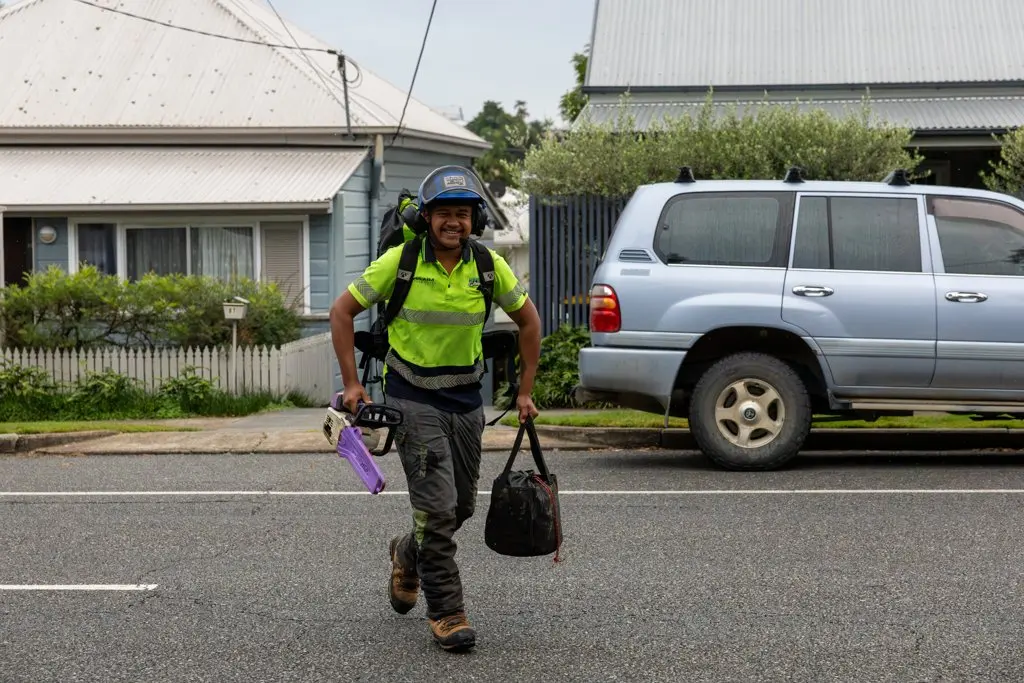
What emergency tree work means
A tree never fails at a convenient hour. It goes over during a southerly change, or a limb lets go at two in the morning and you find it across the bonnet at breakfast.
Emergency tree work is our make-safe callout. Something has already failed, or it's about to, and our job is to take the danger out of it in a controlled way. That might be a gum limb resting on the roof sheets. It might be a jacaranda leaning on the back fence with the root plate lifted out of the lawn. It might be a trunk split through the fork with half the canopy hanging over the kids' trampoline.
We come out, read what's loaded up and under tension, and bring the dangerous parts down in the right order. Then we clean up, so you can get the car out and the kids through the gate.
Who rings us: homeowners, body corporate managers, property managers with a tenant who can't park in the drive, small businesses with a limb over the customer entry, and schools and childcare centres that need a yard cleared before Monday. Some calls come in while the rain is still going. Plenty come three days later, when someone finally looks up and notices the broken branch sitting in the canopy.
Brisbane keeps us busy with this. The older streets around Holland Park and Tarragindi were built when a big shade tree out the back was the whole point, so there are sixty year old gums and figs sitting right over houses that were designed for a much smaller tree. Out towards Capalaba and Alexandra Hills the storms come through with more wind behind them and the soil holds water. Add a wet summer and a 90km/h gust and things start letting go.
Our depot is at Wishart, so most Brisbane jobs are a short run for the crew.
What you notice, and what's actually going on
Nobody rings us using the arborist term. They ring because something looks wrong.
The ones we hear most:
- A branch snapped but caught up in the canopy. We call it a hanger. It can sit there for weeks then drop on a still day.
- A tree leaning that wasn't leaning last week, with a hump of lifted turf on the opposite side of the trunk.
- A crack or a split in the fork where two big stems meet.
- A limb down across the driveway or through the fence, still hanging on by a strip of bark.
- Fresh sawdust, weeping sap, or mushrooms and fungal brackets around the base.
- One side of the canopy gone brown almost overnight.
- A creak or a groan in the wind that the neighbours have started mentioning.
Now the reasons behind them.
Co-dominant stems. Two trunks growing up side by side out of one point, with bark squeezed into the join instead of solid wood. That join is weak from the day it forms. Wet foliage plus wind loads it up and it splits. We see it constantly in camphor laurels, African tulips and poincianas.
Root plate failure. Brisbane clay holds water. After 100mm of rain the soil around the roots goes greasy, the anchoring drops away, and a tree that handled last year's storm fine tips over instead. The giveaway is that lifted lawn behind the lean.
Old root damage. A pool dig, a new driveway, a trench for a pipe. Cut the structural roots on one side and the tree holds on for years, then goes over in the first big blow from that direction. The damage was done a decade before the failure.
Topping cuts from years back. Somebody lopped the tree flat at some point. The regrowth that shoots out of those stubs is attached to dead wood, not sound wood. It grows fast, gets heavy, and tears out.
Decay and termites in the butt. An old wound or a hollow at the base is an open door. By the time the fungus shows on the outside, the wood inside can be soft.
No room for roots. Plenty of blocks around Eight Mile Plains and Upper Mount Gravatt have had concrete, sheds and extensions added over the years. The tree kept growing up. Its roots never got the same room.
Species that just shed. Eucalypts drop limbs in the heat, not only in storms. It catches people out on a calm February afternoon.
None of that means the tree has to go. Sometimes the fix is to take weight off the failed side and leave a sound tree standing. We'll tell you either way, and we won't talk you into a removal you don't need.
How we handle the job, start to finish
You ring 0400 721 715. Troy or one of the boys answers. No call centre.
First thing we ask is whether anyone is under it and whether wires are involved. If a conductor is down, in the tree or across the yard, that's Energex before it's us. Treat every wire as live. We can't safely or legally touch it until the network has dealt with it.
Then we ask for photos. Two or three from a safe distance, one wide and one closer, plus a shot of the access down the side of the house. That tells us whether we're loading a chipper and a climbing kit or whether we need the spider EWP and the rigging gear. It also means we can give you a straight answer on timing instead of a guess.
The site walk. When the crew pulls up, we don't start cutting. We walk it first and work out what's holding what. A limb lying flat can look harmless and still be bent like a spring with a few hundred kilos in it. We look at the lean, the load path, the fence, the roof, the neighbour's shed, and what the rest of the tree does once the failed piece comes off.
Exclusion zone. We tape off the drop zone and ask everyone to stay out of it. That includes the dog and the bloke who wants to film it.
Take the tension out first. Loaded pieces get cut in a sequence that releases them under control, usually with a rope and a lowering device rather than a free drop. Where a piece sits over a roof or a pool, we rig it and lower it. Where there's room and it's safe, we drop it.
Then the rest of the tree. Sometimes that's a reduction to make the tree safe and leave it standing, with cuts made properly so it can seal them. Sometimes the tree is finished and it comes out in sections, climbed or off the EWP.
Clean-up. This is the part the reviews go on about. Limbs through the chipper, trunk sections cut to a size you can shift or we take them away, then rake and blow the paths and the drive. If the machine has been on the lawn, bog mats go down first so you're not left with ruts to fix.
What we don't do is your roof, your fence panel or your insurance claim. We'll get the tree off it and make the area safe. We'll also take photos of what we found and what we did, which helps when the insurer starts asking questions.
The stump comes later. After a tree has gone over, the ground is churned up and soft, so grinding straight away just makes a bigger mess. We clear the tree, give it a few days to dry out, then come back, grind the stump out and chase the surface roots. Standard depth is 100 to 200mm below ground level, deeper if you're laying turf, a slab or a pool. Stumps are where we started in 2015, so this part is home ground for us. Whether it's Mansfield or a tight block at Shailer Park, the narrow grinder that fits through most side gates is the same one that finishes the job.
You'll know what the job involves and what it costs before we start.
Gear and the standards we work to
Storm work needs different gear to a quiet Tuesday removal.
Climbing kit and rigging. Ropes, friction devices and slings let us lower a heavy piece to the ground instead of dropping it. On a tight Brisbane block with a pool, a colorbond fence and the neighbour's patio inside the drop zone, rigging is the only way it goes.
Spider EWP. EWP means elevated work platform, a cherry picker. The spider version tracks through a gate on rubber tracks and legs itself level on a slope. When a tree is already damaged, the safest place for the bloke with the saw is often not in the tree at all. The EWP keeps us out of it.
Chipper and tipper. Limbs go through the chipper on site, so we're not making twenty trips up your street.
Bog mats. Ply and mats under the wheels on soft turf. Storm jobs happen on wet ground, which is exactly when a machine will chew up a lawn.
Stump grinders. We run a few, from a narrow walk-behind that goes through a side gate and down steps, up to bigger machines for a torn root plate and a butt the size of a car bonnet.
The rules we work to:
- AS 4373, pruning of amenity trees. The Australian standard for pruning cuts. If we're reducing a storm-damaged tree rather than removing it, the cuts are made so the tree can seal them, not left as stubs that shoot weak regrowth.
- AS 4970, protection of trees on development sites. This one matters when there's a build going on and trees on the plan to keep.
- Before You Dig Australia. We lodge for underground services before we grind. Water, gas, comms and irrigation all live at grinding depth.
- Powerline exclusion zones. Queensland sets legal minimum distances for working near live lines. We don't cross them. If the work has to happen inside that zone, the network has to make it safe first, and we'll tell you that on the phone rather than after we've arrived and taken your morning.
- Council rules and wildlife. Some Brisbane trees are protected or sit in a vegetation overlay. Storm make-safe work is treated differently to a planned removal, and we'll flag anything that needs a permit. We check for wildlife before starting. If something is living in a hollow, we work around it.
- PPE and paperwork. Helmets, chaps, eye and ear protection on every job. Ask for our insurance details and we'll send them through before we start.
When it's urgent, and what we can honestly promise
Here's the straight version, because storm season gets oversold.
Our hours are 7 days, 6am to 6pm. Outside those hours, call any time for emergencies, 24 hours a day. After a big cell rolls through Brisbane the phone runs hot, so we triage. Anything with people at immediate risk goes to the front: a limb loaded over a bedroom, a trunk on the power line into the house, a blocked only exit. A tree flat across the back lawn with nothing under it waits its turn, and we'll say so on the phone.
Close to the depot is quickest. Around Wishart and Mount Gravatt East we're minutes away. Further out we'll give you a window and ring you if it moves.
We also won't climb or fly a damaged tree in the dark. Storm-damaged wood does unpredictable things and you can't read tension by torchlight.
What to do while you're waiting:
- Keep everyone well clear and don't walk under it. Not for a quick look, not to grab the bins.
- Assume any wire is live. Ring Energex first, then us.
- If there's fire, or someone is hurt or trapped, ring 000.
- Move the cars out from under the tree and off the drop zone.
- Shift the kids to a room on the other side of the house if the lean is over a bedroom.
- Tape the area off so nobody wanders in, including the neighbour's kids.
- Take a few photos from a safe spot and send them through. Good for us, good for your insurer.
- Don't get up there with the ladder and the chainsaw yourself. Most of the bad injuries in this trade happen to people cutting a limb that's under tension.
If the tree is on a shared fence line or hanging into next door, tell us when you call. We'd rather sort out the access and have a word with the neighbour before we turn up with a chipper.
Why people call us for this
Troy started Stump Grind It in 2015 with one grinder. He went out on his own because tree crews kept leaving the stump behind and nobody wanted to come back for it. He still quotes the jobs and he still runs a machine.
His three boys grew up helping on weekends. They came on full time as they finished school, and they're the ones climbing now. Ring us and you get one of the family. The person who quotes it is on site while it's done.
Our Google reviews are five-star. Read a few and the same things keep coming up: turned up when they said, no hidden costs, and the yard was left tidier than they found it. That last one counts for more after a storm than at any other time.
Being on the tools around Brisbane since 2015 means we know the trees and we know the access. We know which streets in Rochedale South have the tight side gates, and which Sunnybank Hills blocks have retaining walls that decide how a tree has to come out.
And we finish the job. Plenty of crews will cut the tree up and leave you with a torn root plate and a mound of dirt where the lawn used to be. We come back, grind it out below ground level, chase the roots that would lift your path, and leave you ground you can mow.
Tree down, limb hanging, or a split you don't like the look of? Ring 0400 721 715 and we'll tell you what needs doing today and what can wait.
Frequently asked questions
What counts as an emergency?
Anything unsafe right now. A limb hanging over the roof, a tree leaning on the fence or across the drive, a trunk split after wind. If people or property are at risk, ring us on 0400 721 715 and we'll work out how urgent it really is.
What should I do before you get there?
Keep everyone well clear and don't walk under it. Move the cars off the drop zone and tape the area off. If wires are involved, ring Energex first, then us. Take a couple of photos from a safe spot and send them through so we know what gear to load.
How quickly can you get out?
It depends on the weather and how many calls are stacked up after a storm. We'll be straight with you on the phone about when the crew can be there.
Do you work 24 hours?
Our hours are 7 days, 6am to 6pm, and outside those hours you can call any time for emergencies, 24 hours a day. We won't climb a storm-damaged tree in the dark, because you can't read tension by torchlight. Ring us at night and we'll talk you through making the site safe until first light.
How do you work out a price for emergency work?
Over the phone from your photos, or on site once we've had a proper look. Storm jobs are all different, so we don't guess blind. Ring 0400 721 715 and you'll know what the job involves before we start.
Do you take the stump out too?
We can. After a tree has gone over the ground is usually soft and torn up, so we clear the tree first and come back to grind the stump and chase the surface roots once it's dried out. Standard depth is 100 to 200mm below ground level, deeper if you're laying turf or a slab.
Will you deal with my insurer?
We don't lodge claims, but we'll photograph what we found and what we did, and we can put the work in writing for you. That's usually what the insurer wants to see. The roof or fence repair itself is a job for your builder or roofer.
Do I need council approval to remove a storm-damaged tree?
Sometimes. Make-safe work on a dangerous tree is treated differently to a planned removal, and some Brisbane trees sit in a protected zone or a vegetation overlay. Tell us the address and we'll flag anything that needs a permit before we start. Call 0400 721 715.