
Tree Removal
We remove trees, from small backyard wattles to big gums that have outgrown the block.
5.0 from 571 reviews
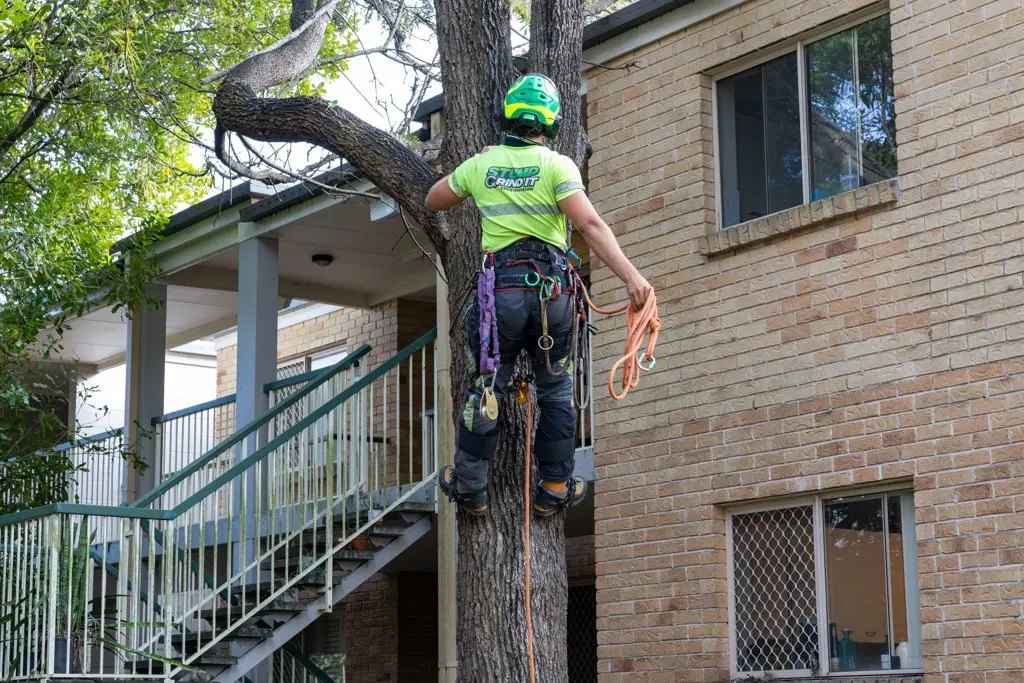
Tree removal across Brisbane
A dead tree in the back corner. A gum leaning further every storm season. Limbs on the roof again.
That's usually what's going on when the phone rings. We're Stump Grind It, a family crew based at Wishart. Troy started the business in 2015 with one stump grinder, because tree crews didn't want to leave someone behind to finish the stumps. His three boys grew up helping on weekends and came on full time as they finished school. Now we take whole trees down too: climbing, rigging, EWP work, and the grind at the end.
Tree removal means the whole tree. Crown, trunk, and the stump out if you want it out. On an open block we can fell a tree in one piece and cut it up on the ground. Brisbane backyards don't often hand you that much room. There's a pool, a shed, a Colorbond fence, and the neighbour's patio sitting a metre off the boundary. So the boys climb it and rig sections down on ropes, one piece at a time. Where climbing isn't the right call, we bring the spider EWP. EWP means elevated work platform, a cherry picker. The spider version walks in on tracks through a side gate and sets up where a truck would never fit.
Most of our removals are houses. The owner has a tree that's died, or one that's outgrown the block, or one the insurer has started asking questions about. We also work for builders clearing a footprint before the slab goes down, agents tidying a yard before it lists, and body corporates with a row of cocos palms nobody wants to touch.
Brisbane is full of blocks that were carved up and planted out between the 1960s and the 1980s. Somebody put a forest red gum four metres off the back step when it was a nice shady sapling. Fifty years later it's 25 metres tall with limbs over two roofs. Same story with the figs and poincianas around Tarragindi and Holland Park, where the streets are older and the trees got bigger than anyone planned for. Out east through Capalaba and Alexandra Hills you've got bay winds and sandier ground, so root plates let go earlier than people expect.
Sometimes a removal isn't the answer. If the tree's sound and just too big for where it's sitting, a proper prune can buy you another ten or fifteen years. We'll tell you that if that's what we see. No sense pulling out a healthy shade tree in a Brisbane backyard when a crown reduction fixes the actual problem, and shade is worth something out here in January.
We quote before anything happens. Troy still quotes the jobs himself. He'll look at the tree, the access, what's underneath and what's next door, then give you a written price and a date before any work starts.
What you're noticing, and what's behind it
Most people don't ring about a tree. They ring because something changed.
Dead branches up top. Bare limbs sticking out above the green. In gums that's often dieback after a dry run followed by a wet one. Our clay soil holds water all summer then cracks hard in winter, and the roots cop both. The top of the crown is the first part to quit.
Limbs dropping out of nowhere. Eucalypts shed. Spotted gums and blue gums let go of big limbs on hot still days with no wind at all. If one's already landed across the driveway, it will happen again.
A lean that's getting worse. Have a look at the ground on the high side of the trunk. Soil lifted or cracked in an arc means the root plate is moving. Don't sit on that one. Ring us.
Fungus at the butt. Brackets or mushrooms on the trunk base or on surface roots usually mean decay in wood you can't see from outside. Plenty of trees look healthy up top and are hollow at the collar.
Roots lifting paths, driveways and pool surrounds. Figs, poincianas and jacarandas are the regulars. Their surface roots run flat and wide chasing moisture, and the damp ground under concrete suits them nicely. We see it constantly through Mount Gravatt East and Mansfield, where the paths went in decades after the trees did.
Drains blocking again and again. Older blocks still run clay sewer lines with joints in them. Roots find the joints. The plumber jets it clear, it's back within a year or two, and eventually the plumber is the one telling you the tree has to go.
The tree is simply too close. Newer builds around Rochedale South and Eight Mile Plains have tight side setbacks. A tree that suited a bigger block now sits half a metre off a boundary fence, under a neighbour's gutter.
Regrowth off a stump somebody left. Camphor laurels, umbrella trees and gums will all shoot again from a cut stump. Poison and a chainsaw won't stop it for long. Grinding it out will.
Leaf litter and gutters. That's not a safety issue by itself. It's still the reason plenty of people finally ring. Cleaning gutters four times a year because of one tree wears thin, especially on a two storey place around Eight Mile Plains.
Termites. A dead tree or an old stump is food sitting in your yard. Termites don't care whether the timber is a stump or a bearer under your floor.
Storm season finishes the job off. From November to March we get westerly cells with hail and hard gusts, and the trees that come down are the ones that were already halfway there. Twin stems with bark pinched between them. A heavy crown all on one side. Decay behind an old flush cut from a pruning job in the nineties. Nothing happens for years, then everything happens in ten minutes.
There's a paperwork side as well. Brisbane City Council protects some vegetation under its local laws, Redland City has its own rules, and plenty of newer estates carry vegetation conditions on the title. We'll tell you what we know at the quote. The approval itself sits with the property owner, so it pays to check with your council before we lock in a date.
How the job runs, from first call to clean yard
You ring or send photos. 0400 721 715. Two pictures help more than a paragraph: one from the base of the tree, one from ten metres back. Text them through if that's easier than talking.
We come out and look. Troy still quotes the jobs himself. He's after three things: the tree, the access, and what sits under and around it. Gate width, step heights, overhead lines, the pool, the septic, the neighbour's new deck. You get a written price, with the stump priced either way so you can decide.
What moves the price around is pretty simple: how big the tree is, how hard it is to get gear to it, and what's underneath it. A gum over a pool and a pergola takes longer than the same gum in an open paddock. That's why we look at it in person instead of guessing over the phone.
Services get located. Before anything goes in the ground we lodge a Before You Dig Australia enquiry and run a locator over the site. Water, sewer, gas, comms, and the irrigation line the last owner ran across the lawn without telling anybody.
Set up and protection. Bog mats go down on turf so the machines don't chew it up. Boards over pavers. We cover pools and garden beds, and we let the neighbours know what's happening if we're working near a shared fence.
The removal. Open access means we fell it, then section it on the ground. Tight access means we climb. The boys take the crown out in small pieces, then rig the trunk down in blocks on ropes through a friction device, so nothing free falls onto your fence. Where a climb isn't safe or sensible, the spider EWP goes in through the side gate and we work off the basket. Palms come down differently again, usually in rings from the top.
Timber goes out as we go. Branches into the chipper. Trunk wood cut to length and loaded into the truck. You're not left with piles to deal with on the weekend.
The stump. This is the part most crews skip. Standard grind is 100 to 200mm below ground level. Deeper if you're pouring concrete, putting in a pool, laying new turf or building over the spot. Root chasing is the extra work on the surface runners that lift lawns and paths, and we'll do that too if the roots are the reason the tree's going in the first place.
Clean up and a walk around. Rake out, blow the paths down, hose the concrete if it needs it. We walk the yard with you before we leave. Want the chip left for the garden beds? Say so on the day and we'll drop a pile in the corner.
Most single-tree jobs are done in a day. Big removals with limited access and several rigging points can run to two or three. We'll tell you which one yours is at the quote, not halfway through it.
Gear and standards
Our gear is chosen for access. Grinders come in a few sizes and the smallest one fits through a standard side gate and walks up steps. Where a wheeled machine can't get in, the tracked gear can. The spider EWP reaches places a truck-mounted lift never will, which describes most Brisbane backyards with a house sitting in front of them. Then there's the chipper, the tip truck, climbing kit, rigging ropes and friction devices, and bog mats for the lawn.
Pruning on trees we're keeping follows AS 4373, the Australian Standard for pruning of amenity trees. Proper cuts at the branch collar, no flush cuts, no stubs left to rot. On building sites we work to AS 4970, the standard for protection of trees on development sites, so the tree that's staying doesn't get wrecked when the one that's going comes out.
Queensland has a code of practice for the amenity tree industry, and it covers the things that hurt people in this trade: chainsaw work, rigging loads, working at height, and keeping the public out of the drop zone. Hard hats, chaps, eye and ear protection, and a proper exclusion zone on the ground. If we ask you to keep the dog and the kids inside for an hour, that's why.
Underground services get located first, every time, through Before You Dig Australia and a locator on site. Overhead is the one people underestimate. Queensland's electrical safety rules set exclusion zones around powerlines, and untrained people are not permitted inside them. If your tree is in that zone we'll say so, and we'll organise it properly rather than having a go at it.
Wildlife gets a look too. Hollows are checked before anything is cut. If there's a nest or an occupied hollow, the plan changes.
Storms, dead trees and jobs that can't wait
Our hours are 7 days, 6am to 6pm. In those hours the phone gets answered by Troy or one of the boys. Outside those hours, call any time for emergencies, 24 hours a day. For anything else, leave a message and we call back first thing.
What we do is shuffle the run. A tree down on your roof, a stem split at the union, a limb hanging over the driveway after a storm: those jobs go to the front. Make safe comes first. Get the weight off the structure, pull the hangers out, take off the part that's about to let go. The full removal and the grind can be booked for later in the week, once nobody's in danger.
If it's live on the powerlines, don't wait for us. Ring Energex and keep everybody well back. If it's on the house with people inside, call 000, and the SES on 132 500 for a tarp and a make safe. Then give us a call and we'll sort the tree out.
Until we get there, park the cars somewhere else and keep everyone out from under the tree. Don't try to pull a hanging limb down with a rope and a towbar. We've seen how that ends. Take photos for your insurer before anything gets moved, because they'll want them later.
Storm season runs November to March down here and the phone runs hot for days after a big cell goes through. You'll get an honest answer on timing. If it's tomorrow, we'll say tomorrow. If it's Thursday, we'll say Thursday, and we'll tell you what to keep the kids and the cars away from in the meantime.
Why people go with us
Our Google reviews are five-star, and customers keep writing about the same things: the quote was straight and the yard was left tidy. That's the business Troy set out to build when he started in 2015.
We're family-run and we're staying that way. Troy would rather explain what's wrong with your tree than talk you into something you don't need. He still quotes, and he's still on the grinder. The boys came up through the business from weekend helpers to climbers.
The clean up is half the reason people call us back. Paths blown, chip raked up, gate shut behind us. We tell the neighbours before we start if we need to work over a shared fence, and we put mats down on turf so you're not left with ruts through the lawn. Small stuff, but it's the part customers mention in the reviews.
The stump is the real difference on a removal job. Stumps are where we started, so the grinders are already on the truck. A combined stump grinding and tree removal booking saves you a second contractor and a second call out. Book a Wishart job or a removal over at Shailer Park and the stump can be gone the same visit. No waiting six weeks with a lump of gum in the lawn throwing shoots.
Ring Troy on 0400 721 715 and we'll come and have a look at it. Send a couple of photos through if that's easier, and we'll tell you what we reckon. stumpgrindit.com.au
Frequently asked questions
What does a tree removal cost?
It comes down to size, access and what's sitting underneath. A gum over a pool and a pergola is a different job to the same tree in an open paddock. Ring us on 0400 721 715 and we'll come out, look at it, and give you a straight price with no surprises later.
Do you take the stump out as well?
We can, and most people do it at the same time. Stumps are where we started, so the grinders are already on the truck. Standard grind is 100 to 200mm below ground level, deeper if you're pouring concrete, putting in a pool or building over the spot. Tell us at the quote and we'll book it with the removal.
Can you get into a tight backyard?
Usually, yes. Our smallest gear fits through a standard side gate and walks up steps. If the tree can't be dropped in one piece, the boys climb it and rig sections down on ropes. On lawn we put bog mats under the machines so the turf isn't chewed up.
Do I need council approval?
Sometimes. Brisbane City Council protects some vegetation under its local laws, Redland City has its own rules, and some blocks carry vegetation conditions on the title. We'll tell you what we know when we quote, but the approval sits with the property owner, so check with your council before we book the job in.
What happens to the timber and branches?
We take it with us. Branches go through the chipper, trunk wood gets cut to length and loaded out, and we rake and blow the area before we leave. If you'd rather keep the mulch for the garden beds, say so on the day and we'll drop a pile in the corner.
How long does a tree removal take?
Most single trees are done in a day, stump included. Big removals with limited access and several rigging points can run two or three days. We'll tell you which one yours is at the quote, not halfway through the job.
What if the tree is near powerlines?
Queensland's electrical safety rules set exclusion zones around powerlines and untrained people can't work inside them. If your tree's in that zone we'll say so at the quote and get it organised properly. If a limb is already on a live line, ring Energex, keep everyone well back, and don't go near it.
Can you come out after a storm?
We work 7 days, 6am to 6pm, and urgent storm jobs go to the front of the run in those hours. Outside those hours, call any time for emergencies, 24 hours a day. We'll make it safe first, then book the full removal and the grind for later in the week. If it's on the house with people inside, call 000 and the SES on 132 500, then ring us on 0400 721 715.